
Asbestos & Domestic Cavity Wall Insulation
Last Updated on 4 August 2026
If you dive into the minefield of asbestos and research any particular topic, an area that provides the most conflicting results is asbestos used as insulation in cavity walls. For example; Crawley Councils website states “Loft or cavity wall insulation does not contain asbestos”. Equally, Southampton Councils website says “Loft or cavity wall insulation does not normally contain asbestos”.
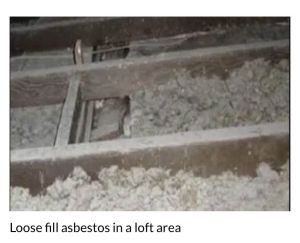
Then we move over to asbestos industry websites which describes how loose fill asbestos insulation can be present in wall cavities, lofts and roof spaces. So, what is the truth? Well, let us start at the beginning.
What is a cavity wall?
Firstly, what is a cavity wall?
A cavity wall is a gap between two walls, usually external walls of a property, which are made up of an outer wall, usually brick or block and an inner wall also usually brick or block. The idea behind the gap is to improve thermal efficiency and reduce moisture ingress within the property.
What is asbestos?
Asbestos is a mined mineral fibre used for a variety of different reasons in different forms. In most cases, asbestos is included within other products and we refer to these as asbestos containing materials (ACM’s). Asbestos can also be found in its natural fibrous form when used within buildings. Asbestos, more importantly, is the largest global and UK cause of work-related cancer deaths. In the UK, around 5000 people die from asbestos related disease annually.
So why would asbestos be present as insulation in a cavity wall?
There are several reasons why asbestos might be used as insulation in a cavity wall, including thermal efficiency and hydrophobic capacity. Starting around the 1960’s in the UK we started filling cavity walls with insulation to make our properties warmer, and then over subsequent years we increased the variety of insulation types.
Loose fill or sprayed asbestos would be perfect for this process as it can be easily blown into the air space/gap of the cavity wall, and brown and blue asbestos are hydrophobic so excellent for effectiveness.
However, having worked in the industry for 40 years, there does not seem to be a great deal of evidence to support any widespread use of this type of asbestos being used in cavity wall insulation, and the evidence is limited where it exists.
One of the reasons may well be that cavities are not routinely accessed as part of an asbestos survey.
Vermiculite used in cavity wall insulation
Loose fill is not the only type of asbestos that could be used in cavity wall insulation. A more popular insulation used was Vermiculite. This type of insulation was used in walls and in lofts and some of the material can be contaminated with asbestos as it is mined in similar rock structure formations as asbestos. Most vermiculite we have tested in the UK has come back negative, but we have had a small number of positive results for asbestos in Vermiculite.
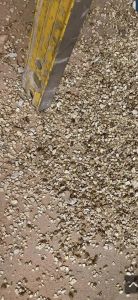
vermiculite used as insulation
Are there other reasons asbestos products could be present around cavity walls?
There are quite a few! Damp proof courses and Damp proof membranes (DPC’s & DPM’s). These are usually bitumen and fabric based products that prevent moisture from rising from the ground (DPC) and coming through the wall (DPM). They frequently contain asbestos from the 1960’s to the 1980’s. They are, however, at the lower risk end of the spectrum of asbestos products due to the small amount of asbestos being firmly bound inside the product.
Another likely product is asbestos air bricks. These are usually cement based and allow air into a property through the external walls. Again, they are at the lower end of the risk spectrum, but they have a higher asbestos content than bitumen-based products.
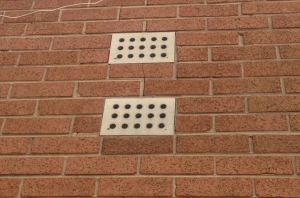
asbestos air bricks
Cavity closers sit at the top of the wall cavity where the roof sits on top of the wall and they are designed to close the wall cavity space where it meets the roof or roof void.
These are more commonly asbestos cement, but they can also be an asbestos insulating board AIB. This is a much more dangerous asbestos product that should only be handled by a HSE licensed contractor. AIB is a much softer board material, and either over time or during original installation, it can be damaged and debris can find its way into the wall cavity. Cavity closers are very common in 60’s and 70’s domestic properties.
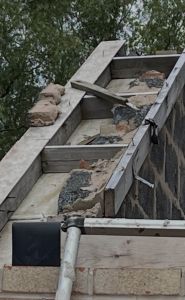
AIB cavity closers
Also ‘finding its way into wall cavities’ and already covered in this article is Vermiculite and loose fill/blown asbestos. If vermiculite or asbestos blown insulation has been used in a roof void and the cavity wall is not covered over where it meets the roof, then there could be an unintentional ingress of material from the roof space to the cavity wall.
Checking a cavity wall for presence of asbestos insulation
In this article, we have covered the possibility of asbestos being present in cavity walls intentionally or unintentionally. Any access to a cavity wall should be taken with care and by an appropriately trained and qualified individual who can take account of the issues covered.
The date of build of a property is very important, as properties built between the 1920’s when wall cavities start to appear more commonly in the UK and the 1980’s would be in the higher risk group for containing asbestos products. Controlled inspection techniques using an endoscope would be a safer way of conducting an initial inspection.
At this point, I need to add another none asbestos element into the cavity wall insulation debate. In the 1970’s and 1980’s (UFFI) Urea Formaldehyde Foam Insulation was a relatively popular cavity wall insulation. Blown into the cavity and over time, the foam can degrade causing toxic fumes to be released which are harmful to humans. It should only be removed by specialist companies. As this is not my area of expertise, I will leave the subject to say, always seek professional advice.
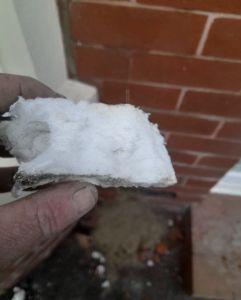
(UFFI) Urea Formaldehyde Foam Insulation
Conclusion – asbestos in cavity wall insulation
In conclusion then, it is wrong or misleading for Council websites to say there is no asbestos used in cavity wall insulation. This might lead a reader to presume asbestos does not appear in cavity walls in any shape or form, which as you now realise, is not in fact correct.
Always seek professional advice – particularly when considering any intrusive or repair works to a domestic property built before the year 2000, when asbestos was banned in the UK. Any work on a domestic property built pre 2000 which affects the fabric of a building should be preceded by a refurbishment/demolition asbestos survey.
Need professional advice?
We hope that you found our latest blog article on asbestos used in domestic cavity wall insulation both interesting and informative. If you need any help or advice in regards to asbestos in your property then we’ll be very happy to assist you. Give us a call and our experts will give you some advice and guidance on whatever if is you’re concerned about.
Please contact us on 0800 141 2676, email us at info@rbasbestos.co.uk or fill in the form below.
Our professional surveyors conduct inspections and surveys every day across the UK on all types of properties, both residential and commercial, for private home owners and commercial property Managers and owners. So when it comes to managing ACMs in your property, you’re in very safe hands with RB!!
Check out our customer reviews on Google.